

undefined
undefined
Functions & Responsibilities
undefined
undefined
undefined
undefined
undefined
undefined
undefined
undefined
undefined
undefined
undefined
undefined
presidenza@sindromerenu.itPublications & Scientific Materials
Pediatrician Awareness Campaign
Awareness campaign targeting Italian pediatricians and general practitioners on ReNU Syndrome: distribution of informational materials, contacts with scientific societies and medical associations to reduce diagnostic times and ensure the correct diagnostic pathway (WGS).
Get updatesConditions Associated with ReNU Syndrome
ReNU Syndrome may be associated with specific neurological conditions requiring dedicated clinical attention. Knowledge of these correlations is essential for effective multidisciplinary care.
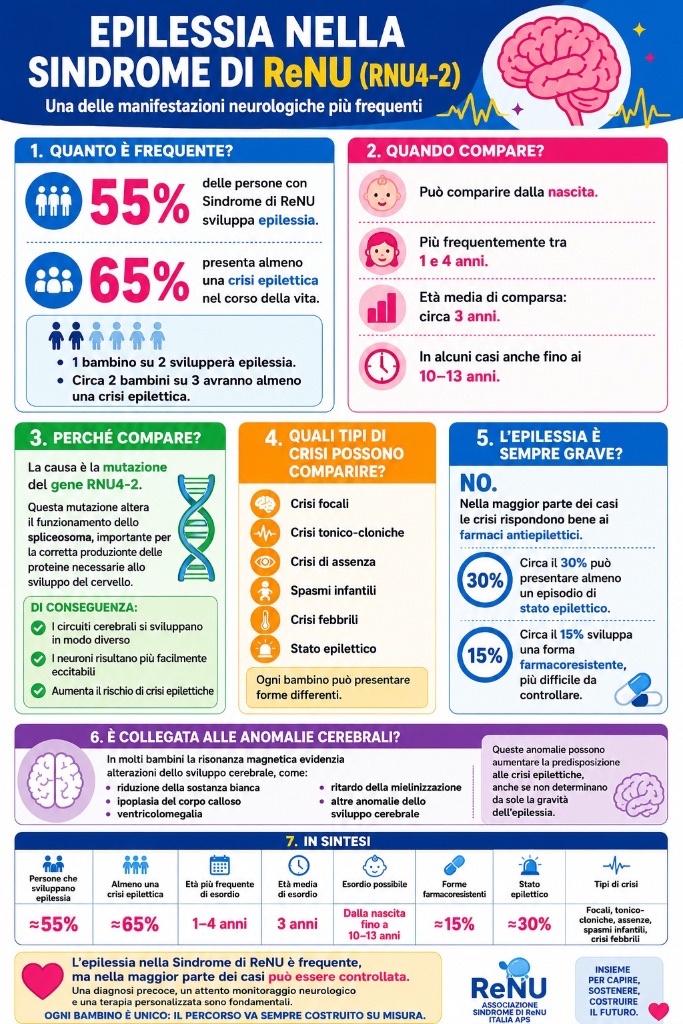
Epilepsy / Seizures
Monitoring recommendedEpileptic seizures represent one of the most significant neurological manifestations of ReNU Syndrome. They may present in different forms: infantile spasms, focal seizures, tonic-clonic seizures, complex febrile seizures or status epilepticus. Their presence, frequency and severity vary from patient to patient and require specialist neurological evaluation.
Infantile spasms
Brief, recurrent muscle contractions, often associated with hypsarrhythmia on EEG (West syndrome).
Focal and tonic-clonic seizures
Seizures originating from a localised brain area (focal) or generalised with loss of consciousness and muscle stiffening (tonic-clonic).
Complex febrile seizures
Seizures triggered by fever, more prolonged or repeated than simple febrile seizures; require neurological monitoring.
Status epilepticus
Prolonged seizure (>5 minutes) or series of seizures without recovery of consciousness. It is a medical emergency requiring immediate intervention.
Clinical note: Seizure management in ReNU patients requires EEG assessment, neuroimaging and an individualised therapeutic plan. Antiepileptic drug treatment must be adapted to the patient's specific clinical profile. International ReNU research is collecting data on the epileptic profile of the syndrome to improve treatment guidelines.
undefined
Are you a physician, researcher or specialist interested in collaborating with the Scientific Committee? Write to us to propose scientific contributions or flag relevant publications.